Forest Planning System
Overview of the System
Unregulated logging and development can lead to forest degradation, which cause disasters such as landslides as well as wind and flood damage. Unplanned logging also leads to the depletion of forest resources and may cause serious disruptions to the stable supply of forest products. Since reforestation requires a long period, it is difficult to restore forest functions once they have been damaged. As a result, such degradation can lead to significant impacts on the national economy.
Accordingly, the Forest Planning System was established under the Forest Act to ensure planned and appropriate forest management from a long-term perspective.
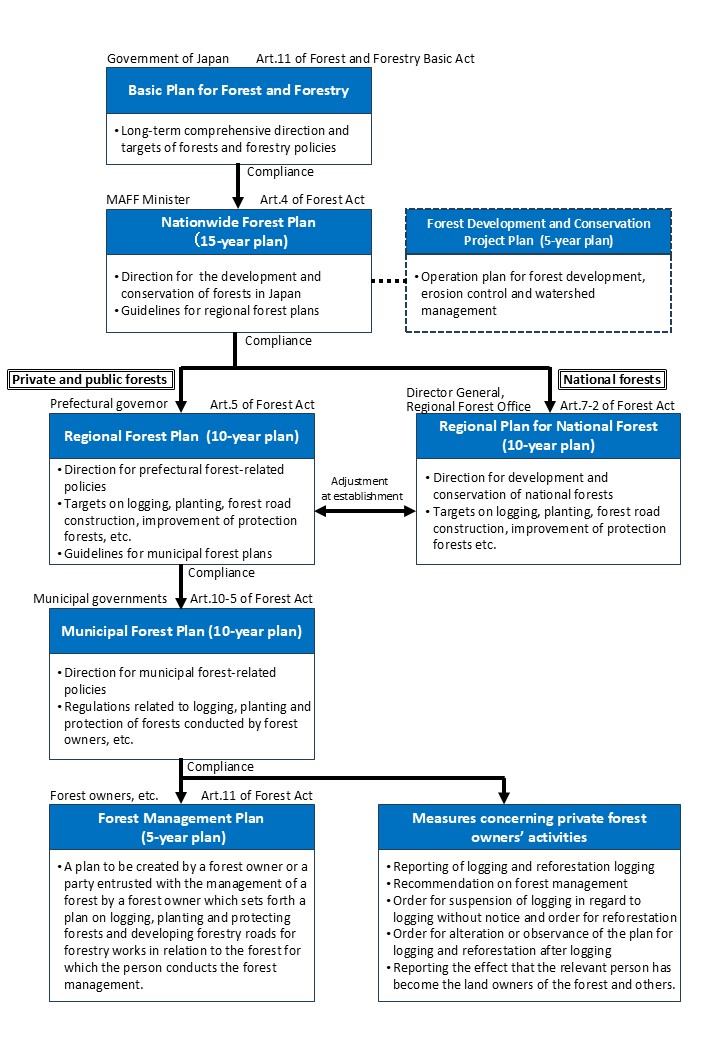 |
Municipal Forest Plan
Municipal Forest Plan is 10-year plans created every five years by municipalities that include privately owned forests covered by Regional Forest Plans. These plans outline a long-term vision for forest management, taking into account the unique characteristics of the local forests and forestry industry. They define the basic principles for forest development, zoning, standard methods for forest operations tailored to local conditions, regulations for forest protection, and plans for road network development.
The purpose of these plans is to promote proper forest development by having municipalities—the administrative bodies closest to the community—work in concert with prefectural governments and forestry stakeholders. This ensures that relevant measures are implemented with the understanding and cooperation of local residents, reflecting the specific needs of the region.
Forest Management Plan
Forest Management Plan is a 5-year plan created by a forest owner or a person entrusted with forest management. It is designed to cover a cohesive forest area under their management, detailing the methods for forest operations and protection.
The objective of these plans is to ensure that the diverse functions of forests are fully realized. This is achieved through efficient forest operations and appropriate forest protection, all based on a cohesive plan for the managed forest area.
In March 2025, the format of Forest Management Plan was revised in line with "Guidelines for forestry management to Enhance Forest Biodiversity." This revision enables the implementation of a PDCA cycle for biodiversity conservation through the creation of a Forest Management Plan.
Contact
Forest Multiple Use and Conservation Division, Private Forest Department, Forestry Agency
1-2-1 Kasumigaseki, Chiyoda-ku, Tokyo 100-8950, Japan
Some of the publications on this site are in PDF.
To view them you will need to have Adobe Reader.
Please download Adobe Reader.